- Les Adore Community
- Posts
- Slice Of Life Community
Slice Of Life Community
Your personal and exclusive serving of Culture, Community, and Lifestyle.

Amina Salahou
January 15, 2026
In partnership with

Editor in Chief: Cynthia Medina
Introducing: Chez Les Adore for NYFW SS26⭐

Les Adore is bringing Chez Les Adore to NYC for the NYFW season. Join us on the 15th of February at 7pm for a curated winter-night soirée with chic company and a few surprises throughout the evening. Tickets drop in next week’s column– and you’ll want to be on that list.
RSVP for early access: https://partiful.com/e/Lesadore-earlyaccess-NYFW
By Kennedy Chambers
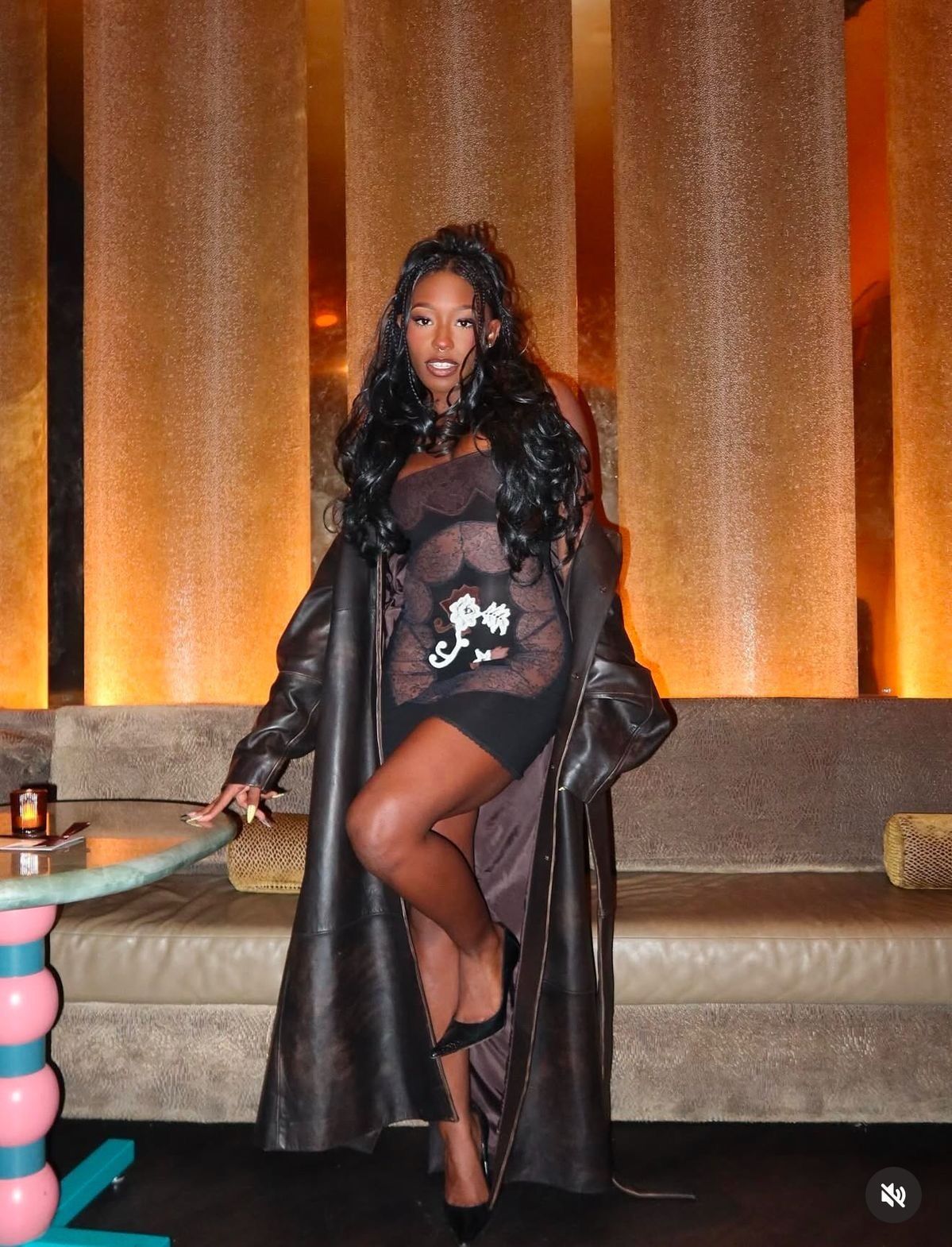
What to Wear for a Winter Birthday❄️
If you're anything like me, a December baby, you’re probably asking: What am I going to wear for my birthday? It’s hard balancing chic and warm, but these outfit formulas make it easy.
Mesh mini dress + fur
For the girls who want a summer silhouette without freezing.

Maxi long sleeve dress
You can never go wrong with a maxi in the winter. Bonus points if you add a fur hat for that true winter-chic moment.

@iamgia Elery dress: $125 and Fur wrap around hat
Trench + mini dress
Not into fur but still love a short hem? Pair a cocktail mini with a classic trench. (A nasty heel would be perfect here, too.)
Fur trim jacket and statement boot
Chic, warm, and guaranteed to turn heads. We also love a monochrome moment with this combo.

Sweater dress
The iconic winter birthday staple. Pair with heels or boots and you’re instantly celebration-ready.

Whatever you wear, make it warm enough to stay out late and cute enough to be remembered!🧁
Classism in Clothing (part 1)💸
A recurring theme with this column is that fashion has consistently served as a strong cultural reflection of the social structure, philosophies, and views of its time. Specifically, fashion’s primary evolution in history has been as a means of cultural capital, meaning it can be a way to signal someone’s social class or status.

This makes sense; after all, the anatomy of someone’s outfit is often influenced by various “unintended” factors, such as education, accessibility, exposure to trends and influence, social expectations, and affordability. All of these are directly linked to social class – time and money are the big differentials that define the gap between classes, and if a person has a deficiency of these aspects, it makes a huge difference in the resources and items they have access to.
Additionally, clothing condition, materials, and design may also be influenced by people’s employment, which is a direct reflection of their social class as a defining factor of their income. Workwear, for example, was heavily adapted by many manual labor workers, often in lower classes, due to its structural integrity, durable materials, and ability to withstand the tests of wear and time.

But when we dive into the humble origins of clothes, we see that clothes were originally created as a functional tool for human survival. So…how did we end up here?
Next week, we’ll begin a journey to explore how clothing historically evolved from its practical function to one reflecting social status and class. Stay tuned!
2026, BE KIND!😊
Bold maximalism is officially back in 2026, and subtlety has left the group chat. This year is about leaning all the way in—more color, more texture, more personality. Morning routines start with the least performative type of matcha, preferably from Chamberlain Coffee, because taste and branding matter.

Beauty is playful again: funky nail art, mismatched designs, and tiny decals turn your hands into conversation pieces.

Next up: the biggest trend prediction of 2026. Adidas Gazelles—aka Satellite Stompers—are everywhere, especially styled with shoe charms and confidence. Welcome back, Harry Styles, cultural patron saint of doing the most. Maximalism isn’t chaos; it’s intention turned all the way up. Being extra is the POINT!

Easy setup, easy money

Making money from your content shouldn’t be complicated. With Google AdSense, it isn’t.
Automatic ad placement and optimization ensure the highest-paying, most relevant ads appear on your site. And it literally takes just seconds to set up.
That’s why WikiHow, the world’s most popular how-to site, keeps it simple with Google AdSense: “All you do is drop a little code on your website and Google AdSense immediately starts working.”
The TL;DR? You focus on creating. Google AdSense handles the rest.
Start earning the easy way with AdSense.

By Victoria Gonzalez
The Year of Memorabilia.🎞️
In 2025 I saved receipts, concert tickets, flowers, stickers, and love letters. For someone who loves to hold onto ephemera, these items were often misplaced, ending up at the bottom of bags or in jacket pockets. I’ve never been able to scrapbook, so the few lucky items I remember to keep abide in an old cigar box in my room at home. But this method of archiving often fails me.
In 2025 I took an endless amount of pictures. I never seem to escape the amount that I have accumulated over the years. My iCloud is on the verge of collapse. I have pictures upon pictures that I rarely ever look through. This year, I am shifting away from digital media. I found a better way to preserve memories.
In 2026, The Year of the Horse, The Year of Analog, I will not lose my memorabilia, because I’ll have somewhere to keep it with me everywhere I go. As an alternative to the Louise Carmen journal, I have this one from Amazon. Though less intricately crafted, it is an equally beautiful, customizable, and convenient vessel for my thoughts, bad poetry and sentimental tokens.

LIKE AND COMMENT FOR A TBH AND RATE✍️
In an age of hypersurveillance, it feels like everyone is watching you. Even casual in-person run-ins with old classmates is like searching for a way to assure everyone that you are living the dream.
We’re sick of this performative culture and yearn for authenticity, yet these differing perspectives lie solely in subjectivity. Where does performativity end and authenticity begin?
Matcha lattes, baby tees and wired headphones are at the core of performative fashion, but now the “performative” label spans to nearly every fashion item. Curated outfits and Instagram feeds became hypercurated lifestyles, and external validation for likes and comments for social currency. Performative fashion functions by pleasing audiences through leveraging social currency. Authentic fashion functions by pleasing the subject through rejecting social currency. But perception, and thus performativity, a primary vehicle for fashion, is uncontrollable.

Performative style is simply a fear-driven sociological concept applied to fashion and art. Performativity and authenticity are not a binary, but rather a part of an infinite spectrum of fear and confidence.
Style is self discovery. “2026 is the new 2016”-- but are you ready to have the confidence to wear a matching emoji print sweat suit? (I am NOT endorsing this fit, but you get my point.) Embarrassment is inevitable, a necessary part of growth in a lengthy journey. There is no such thing as “perfection”, or “truly fitting in” because fashion, like self discovery, is inherently a means of expression. Without risk, there is no reward, and without guts, there is no glory.
So, yes, performative fashion might just be “fashion’s next big wave”, but there’s no way to avoid the performative allegations– only to embrace it.

While we’re all in one of the most formative points in our lives, our fashion is paralleling that too. Absent-mindedly following fashion trends has conservative echoes of creating a shared mentality, one that makes differences turn into isolation. Spring cleanings and shopping sprees often represent a cleansing of the old and rejuvenation of the new– for both your closet and your mindset. And much like self-discovery in your early-20s, the only way to escape this “performative” asylum is to find what authenticity means to you.
By Sarah Shrader
The Year I Ask for More🐎
Everyone, wake up, it’s a new year! And with the arrival of 2026 comes the fresh wave of New Year’s resolutions.

This year, I made my first vision board. It’s filled with everything I want in 2026 and beyond. I’ll admit, I felt a little greedy curating it. Who was I to expect so much out of life?
Then I saw a quote that shifted my whole perspective: “Ask for more, the universe isn’t on a budget.” It reminded me there’s no reason I can’t build a spectacular life. Of course, nothing will fall into my lap. Most of it will take years of dedication and effort, but I do believe the universe meets you when you’re willing to meet it, too, as long as you take the actions to receive what you’re asking for.
For me, my resolution is actually slowing down. I want to do the splits, land my dream internship (fingers crossed), deepen my friendships, and finally, finally make room for a relationship, something I’ve claimed I’ve been too busy for in the past.
2026 is the year of the Fire Horse, said to bring energy, adventure, and freedom. Honestly, I can’t wait to see what it brings. So what are you challenging yourself to reach for this year?
Next week: sorority rush, lol.
By Clementine Gnoto
What Does It Mean When The Gaze Shifts?

Have you ever wondered how much of what we call “normal” is really just about who’s holding the power? That’s the quiet provocation at the heart of The United States of Africa by Abdourahman Waberi.
The book imagines a world flipped on its head, where Africa is the global superpower and Europe is fractured, poor, and dependent. It’s not a gimmick, and it’s not satire for satire’s sake. It’s a mirror and depending on where you stand, you might not love what you see. If that discomfort sets in, if you begin to reflect on how sick and twisted many real-world atrocities are, it becomes important to question yourself and ask why.
What struck me most wasn’t the politics, but the way dignity moves through the book. Who is allowed to travel freely?, who is assumed to be intelligent?, who receives sympathy at borders?, and who is labeled “exotic,” “dangerous,” or “uncivilized.”? It echoes a narrative we are already witnessing in the world today. The book doesn’t pretend that power makes anyone morally superior. Oppression doesn’t disappear just because the map changes; it simply finds new bodies, new borders, and new excuses. And that’s the point. The problem isn’t geography, it’s the systems that decide whose humanity is negotiable.
So where does that leave us and where might we go from here?
See you next week!
